Newly Declassified Documents Reveal Remarkable Continuity with Today's U.S.-Iran Nuclear Controversy
National Security Archive Electronic Briefing Book No. 268
Edited by William Burr
For more information contact:
William Burr - 202/994-7032
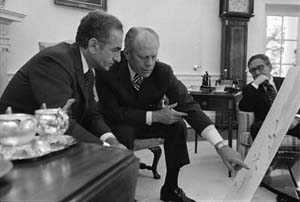
President Gerald R. Ford and the Shah of Iran confer over a map during the Shah's May 1975 visit to Washington, D.C. Secretary of State Henry Kissinger sits in the background. (Photo courtesy of Gerald R. Ford Presidential Library)
Washington, D.C., January 13, 2009 - During the 1970s the Shah of Iran argued, like current Iranian leaders today, for a nuclear energy capability on the basis of national "rights," while the Ford and Carter administrations worried about nuclear weapons possibilities, according to newly declassified documents published today by the National Security Archive for the first time. Uranium enrichment capability is now the major point of controversy between Tehran and the world community, while during the 1970s Washington's greatest concern was that Iran sought a capability to produce plutonium, but in both instances the implication was that a nuclear weapons option might not be far away.
The documents, obtained by the Archive through a mandatory review request, show that two U.S. presidents dealing with the Shah of Iran, Ford and Carter, put concerns over proliferation and the Shah's possible desire to build a nuclear bomb front and center when they approved negotiating positions for a deal to sell nuclear reactors to Iran. While Iranian officials argued then, as they do today, that Iran had "rights" under the Nuclear Nonproliferation Treaty to develop nuclear technology, the U.S. government successfully sought an agreement that put nonproliferation controls over U.S.-supplied nuclear material.
The 1979 Iranian Revolution derailed the agreement, but the approach that the Ford and Carter administrations took shows significant continuity with contemporary U.S. and world policy, which holds that Iran must not use its technological capabilities to produce nuclear weapons. The documents contradict the 2005 claim by former Secretary of State Henry Kissinger that non-proliferation was not an issue in the 1970s negotiations; this was a "commercial transaction," Kissinger told The Washington Post.
The 1970s nuclear negotiations have other parallels with the current situation. The Bush administration has raised questions about Iranian claims that its interest in a nuclear energy program are peaceful, while the declassified record indicates that U.S. policy-makers during the 1970s were also skeptical of, but ultimately willing to accept, the Shah's similar claims, as long as a nuclear agreement with Iran restricted its freedom of action in the nuclear field. Significantly, the Bush administration also disparages Iran's assertion that it needs to develop alternative fuels in anticipation of the eventual decline in the country's extensive oil reserves. But the Shah and his government made the exact same statements in the 1970s.
The record also shows that the Shah's regime and the current Iranian government have made the same claims that their pursuit of nuclear technology was an inherent national entitlement. No country "has a right to dictate nuclear policy to another," said the Shah's chief atomic energy official in 1977.
Among the disclosures in the new documents:
- In 1974 Department of State officials wrote that if the Shah's dictatorship collapsed and Iran became unstable, "domestic dissidents or foreign terrorists might easily be able to seize any special nuclear material stored in Iran for use in bombs." Moreover, "an aggressive successor to the Shah might consider nuclear weapons the final item needed to establish Iran's complete military dominance of the region."
- According to national security adviser Brent Scowcroft, the Ford administration hoped that the Shah would commit himself to a "major act of nuclear statesmanship: namely, to set a world example by foregoing national reprocessing."
- When officials from Oak Ridge National Laboratory received briefings on the planned Esfehan Nuclear Technology Center (ENTEC), they concluded that the "bears watching" because "unusually large" size of the facility "makes it theoretically possible to produce weapons-grade material (plutonium)" and the ENTEC plans include a "large hot lab," the first step toward reprocessing.
- Questioning U.S. efforts to restrict Tehran's freedom of action, Iranian officials argued that "Iran should have full right to decide whether to reprocess" and the "right to effective control of the management and operation of … reprocessing facilities."
- By the summer of 1978, Tehran and Washington had overcome differences and agreed to a nuclear pact that met U.S. concerns and the Shah's interest in buying reactors, but the agreement closely restricted Iran's ability to produce plutonium or any other nuclear weapons fuel using U.S. supplied material without Washington's "agreement."
Drawing on the new documents, National Security Archive senior analyst William Burr has written an article to give perspective to the nuclear talks: "A Brief History of U.S.-Iranian Nuclear Negotiations," now appearing on-line in the January-February 2009 issue of The Bulletin of the Atomic Scientists. While the documents available so far illuminate the negotiations, more needs to be learned from U.S. government files. To a great extent the intelligence side of the story remains an unknown. So far, the Central Intelligence Agency has denied all documents gleaned from the Archive's mandatory review request, although they are presently under appeal.