Iraq said Thursday it will bar Blackwater Worldwide from providing security protection for U.S. diplomats because its contractors used excessive force, sanctioning a company whose image was irrevocably tarnished by the 2007 killings of 17 Iraqi civilians.
The move will deprive American diplomats of their main protection force in Iraq.
The decision not to issue Blackwater an operating license was due to "improper conduct and excessive use of force," said Iraqi Interior Ministry spokesman Maj. Gen. Abdul-Karim Khalaf.
Iraqis are bitter over the September 2007 killing of 17 Iraqi civilians in Baghdad's Nisoor Square. Five former Blackwater guards pleaded not guilty Jan. 6 in federal court in Washington to manslaughter and gun charges in that shooting. A sixth is cooperating with the government.
read more digg story
Showing posts with label Blackwater. Show all posts
Showing posts with label Blackwater. Show all posts
Thursday, January 29, 2009


Monday, December 8, 2008
Will charges against Blackwater guards stick?
By Alex Koppelman
The most important question may not be their guilt or innocence in the shooting of Iraqi civilians, but whether they're even subject to U.S. law.
Five Blackwater security guards have surrendered to federal authorities after they were indicted on charges relating to a 2007 incident that left 17 Iraqis dead. A sixth has already agreed to a plea deal with prosecutors.
The Associated Press reports that defense attorneys are already "filing court documents challenging the Justice Department's authority to prosecute the case." This isn't surprising. In a 2007 article, Salon's Mark Benjamin and I explored the legal limbo that was created in Iraq for private security guards like the ones charged Monday. "We've painted ourselves in a corner," Peter W. Singer, an expert on private security contractors who is a senior fellow at the center-left Brookings Institute explained at the time. Many questions remain about who -- if anyone -- has jurisdiction over these guards, and whether they can legally be prosecuted at all. This case may end up as an important test, and could have larger implications for contractors in Iraq and elsewhere.
The five guards are each charged with 14 counts of manslaughter and 20 counts of attempted manslaughter, as well as with using a machine gun to commit a crime of violence. According to the AP, that last charge carries a 30-year minimum prison sentence.
read more digg story
The most important question may not be their guilt or innocence in the shooting of Iraqi civilians, but whether they're even subject to U.S. law.
Five Blackwater security guards have surrendered to federal authorities after they were indicted on charges relating to a 2007 incident that left 17 Iraqis dead. A sixth has already agreed to a plea deal with prosecutors.
The Associated Press reports that defense attorneys are already "filing court documents challenging the Justice Department's authority to prosecute the case." This isn't surprising. In a 2007 article, Salon's Mark Benjamin and I explored the legal limbo that was created in Iraq for private security guards like the ones charged Monday. "We've painted ourselves in a corner," Peter W. Singer, an expert on private security contractors who is a senior fellow at the center-left Brookings Institute explained at the time. Many questions remain about who -- if anyone -- has jurisdiction over these guards, and whether they can legally be prosecuted at all. This case may end up as an important test, and could have larger implications for contractors in Iraq and elsewhere.
The five guards are each charged with 14 counts of manslaughter and 20 counts of attempted manslaughter, as well as with using a machine gun to commit a crime of violence. According to the AP, that last charge carries a 30-year minimum prison sentence.
read more digg story
Thursday, November 13, 2008
Blackwater To Be Fined For Illegal Weapons Shipments to Iraq
by Bruce Falconer - Blackwater Worldwide is facing a "multimillion-dollar" fine from the State Department for allegedly shipping over 900 illegal weapons to Iraq without the required paperwork. The arms were shipped directly from Blackwater's North Carolina headquarters, hidden in shrink-wrapped pallets. Some wound up on the Iraqi black market.
read more | digg story
read more | digg story
Thursday, October 25, 2007
Blackwater Launches Campaign Urging Supporters To ‘Influence’ Congress
 Blackwater sent an e-mail blast today, encouraging supporters to contact “elected Congressional representatives” with “letters, e-mails and calls” with the goal of “influencing the manner in which they gather and present information.” Blackwater also provided “suggested themes” for supporters to follow...
read more digg story
In the past two weeks, Erik Prince, the CEO of embattled private security firm Blackwater USA, has orchestrated an aggressive public relations campaign in efforts to save his company’s reputation in the face of multiple scandals. In his media blitz, Prince has given interviews to The Washington Post, Newsweek, The Wall Street Journal, CNN’s “Late Edition with Wolf Blitzer,” CBS’ “60 Minutes” and PBS’ “Charlie Rose” amongst others.
As the next step of the PR campaign, Blackwater sent an e-mail blast today, encouraging supporters to contact “elected Congressional representatives” with “letters, e-mails and calls” with the goal of “influencing the manner in which they gather and present information.” Blackwater also provided “suggested themes” for supporters to follow:
- Cost efficiency of Blackwater — saving the US taxpayer millions of dollars so
that the US Government doesn’t have to take troops from their missions or send
more into harms way
- Professional population of service veterans and mature law enforcement personnel
- Sacrifice in lives lost by Blackwater saving US diplomats without one single protectee harmed
Blackwater’s claim to cost efficiency is specious at best. According to documents made available to the House Oversight and Government Reform Committee, “It costs the U.S. government a lot more to hire contract employees as security guards in Iraq than to use American troops.”
According to the data, “the average per-day pay to personnel Blackwater hired was $600,” which is significantly more than uniformed soldiers:
An unmarried sergeant given Iraq pay and relief from U.S. taxes makes about $83
to $85 a day, given time in service. A married sergeant with children makes
about double that, $170 a day.
Army Gen. David H. Petraeus, the top U.S. commander in Baghdad overseeing more than 160,000 U.S. troops, makes roughly $180,000 a year, or about $493 a day. That comes out to less than half the fee charged by Blackwater for its senior manager of a 34-man security team.
Read the full e-mail here.

Monday, October 8, 2007
Saturday, October 6, 2007
Blackwater in the Quagmire: Does USA's Most Powerful Private Militia Fuel Iraq's Insurgency?
In its role as America's most powerful for-profit private militia, Blackwater USA seems to have much to gain in sustaining the Iraq insurgency. Could that be part of the reason for its reckless and deadly behavior?
read more digg story
From "Blackwater in the Quagmire: Does USA's Most Powerful Private Militia Fuel Iraq's Insurgency?"
by Anthony Barnes Page 1 of 2 page(s)
http://www.opednews.com/
The accounts, chronicled in a congressional Oversight Committee memo, are nothing short of disturbing.
These acts, brutish, savage, indeed violently deviant though they may be, are nevertheless among war's inevitable realities, we're often told. Indeed, it's also been argued that such acts are perhaps more likely to be expected in wars waged against a guerilla-style insurgency which -- at least among many Iraqi insurgents -- transcends the material vestiges of the here and now. In these "unconventional" wars, the shadowy enemy one faces sees his effort as one of not just ridding his country of its invaders, but also as a means of attaining martyrdom.
Nevertheless, though well aware that the casualties of war accrue in a variety of manifestations, for more than a few Americans, the skittish and malevolent, trigger-happy attitude these incidents depict, come, like the Abu Ghraib scandal, as a complete shock.
Meanwhile, to anyone acquainted with the outré, turgidly cocksure, over-the-top personality type of the former Navy Seals, Special Ops-types, and other gung-ho para-militarists embodying the ranks of private militias wherever found, none of the extremes come as a surprise.
In fact, precisely because war is hell, one such type, Blackwater Worldwide founder and former Navy Seal Erik Prince, would like us to believe that his private, for-profit heavily-armed and equipped adjunct to the U.S. military, serves as a bulwark shielding the "civilized" of Iraq, namely: diplomats; Iraqi or foreign government officials; U.S. politicians; and, of course, well-heeled disaster capitalists, from the unfettered mayhem and the senses numbing carnage reported in places like Baghdad and Fallujah.
Prince insists that we view the role of his Blackwater contingent in Iraq -- none of whom are constrained in their actions by the Uniform Code of Military Justice; and each of whom enjoys complete immunity from Iraqi courts -- as a detachment designed to enable the 160,000 member U.S. force in Iraq to more adroitly damper down the insurgency and stabilize a nation of 27 million packed in an area roughly the size of California.
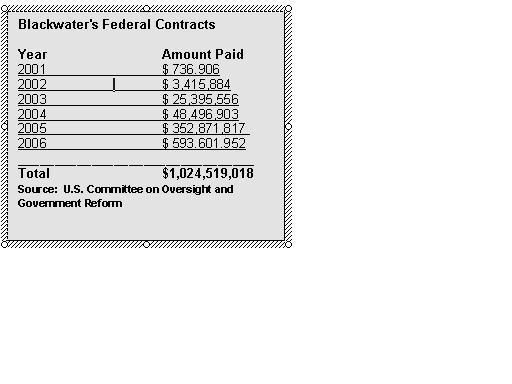
In its own way, Prince would further insist, Blackwater Worldwide is doing its part to help bring "freedom and democracy" (author's quotes) to the volatile Middle East. He'd love us to believe that, by accepting dangerous security assignments -- protecting construction projects, ministries and oil fields; escorting diplomatic convoys; and serving in a wide range of additional life-threatening capacities in the harrowing mise en scene which is Bush-era Iraq, -- Blackwater, rather than a feckless siphon of more than a billion U.S. taxpayer dollars (see graph), is in fact, an invaluable commodity that prevents the siphoning of needed U.S. soldiers from Iraq's urban war zones.
In his early October appearance before the congressional Oversight and Government Reform Committee, Prince, once an intern for George H.W. Bush, asserted that Blackwater's contributions have had a positive impact on the war effort.
"Our professionals work to keep American officials and dignitaries safe, including visiting members of congress," Prince insisted. "In doing so, more American service people are available to fight the enemy."
Defense Secretary Robert Gates' September testimony before the Senate Appropriations Committee seemed to imply that he sees it a bit differently. Gates' testimony included expressions of concern over the practice by Blackwater and other for-profit militias of offering high salaries to entice soldier into leaving the military. Gates said he'd like to see legal barriers imposed against the practice.
But beyond that issue, it would seem that through its ongoing lethally-reckless behavior, Blackwater continues to pollute any pool of goodwill that ensue U.S. military efforts to win Iraqi hearts and minds, all but ensuring the improbability that the need for U.S. soldiers in Iraq can be abridged anytime soon. Additionally, among private for-profit militias like Blackwater, for which continued social and political instability clearly translates into a stable profit flow, having the added bonus of immunity from criminal liability is yet another corporate perk.
The impression that instability serves as the obvious lifeblood of Blackwater is evident not only in the steady growth it has enjoyed as a company since attaining its original no-bid assignment from the State Department to work in Baghdad and Al-Hillah. Blackwater's use-of-force record, which, according to the State Department is "frequent and extensive," could be seen as another indicator of this for-profit, private militia's relish for mayhem.
According to the Oversight Committee report, though legally bound to engage only in defensive use of force, "...in practice, the vast majority of Blackwater weapons discharges are preemptive, with Blackwater forces firing first ... prior to receiving any fire."
It seems clear that as long as for-profit private militias like Blackwater are permitted to operate with such indiscriminate and deadly impunity with immunity from local prosecution, it seems assured that the continued presence of U.S. soldiers will remain vital to offset the wave after wave of new "enemy" spawned by blowback from Blackwater's lurid standard operating procedures, an operating procedure that, again, tends to produce a very profitable bottom line for Blackwater.
In the social services arena, there's a popular, if not utopian notion that in the best case scenario, social workers will do their jobs so well that they will succeed in ending poverty, illness and all forms of social malaise. The ironic endgame to that success is that the social workers would basically put themselves out of a job.
read more digg story
From "Blackwater in the Quagmire: Does USA's Most Powerful Private Militia Fuel Iraq's Insurgency?"
by Anthony Barnes Page 1 of 2 page(s)
http://www.opednews.com/
The accounts, chronicled in a congressional Oversight Committee memo, are nothing short of disturbing.
- In November, 2005, in an act even Blackwater officials acknowledged as outright, "random negligence," a Blackwater-guarded motorcade on its way to an Iraqi Oil Ministry basically demolished 18 civilian vehicles -- six on its way to the ministry, and another dozen during the return trip.
- In December, 2006, a deeply intoxicated Blackwater contractor, apparently without provocation, gunned down a guard for Iraqi Vice President, Adil Abd-al-Mahdi and was quickly spirited out of the country by Blackwater.
- On September 9 of this year, Batoul Mohammed Ali Hussein, a clerk in the Iraqi customs office in Diyala province, was killed when Blackwater security contractors responded to rocks throwing with a barrage of automatic weapons fire into a crowded intersection. Witnesses reported a Blackwater guard shot Hussein repeatedly after she had struggled to her feet. Four other Iraqi civilians were killed in the incident.
- In other incidents, each cited in State Department documents, Blackwater forces shot a civilian bystander in the head; sought to cover up a shooting that killed an apparently innocent bystander; and provided no assistance after a traffic accident caused by its "counter-flow" driving protocol left an Iraqi vehicle in "a ball of flames."
- Then there was the recent widely publicized incident of September 16 this year, when a Blackwater contingent fired indiscriminately into a crowd killing anywhere between 11 and 17 Iraqi civilians, and wounding an additional 24.
These acts, brutish, savage, indeed violently deviant though they may be, are nevertheless among war's inevitable realities, we're often told. Indeed, it's also been argued that such acts are perhaps more likely to be expected in wars waged against a guerilla-style insurgency which -- at least among many Iraqi insurgents -- transcends the material vestiges of the here and now. In these "unconventional" wars, the shadowy enemy one faces sees his effort as one of not just ridding his country of its invaders, but also as a means of attaining martyrdom.
Nevertheless, though well aware that the casualties of war accrue in a variety of manifestations, for more than a few Americans, the skittish and malevolent, trigger-happy attitude these incidents depict, come, like the Abu Ghraib scandal, as a complete shock.
Meanwhile, to anyone acquainted with the outré, turgidly cocksure, over-the-top personality type of the former Navy Seals, Special Ops-types, and other gung-ho para-militarists embodying the ranks of private militias wherever found, none of the extremes come as a surprise.
In fact, precisely because war is hell, one such type, Blackwater Worldwide founder and former Navy Seal Erik Prince, would like us to believe that his private, for-profit heavily-armed and equipped adjunct to the U.S. military, serves as a bulwark shielding the "civilized" of Iraq, namely: diplomats; Iraqi or foreign government officials; U.S. politicians; and, of course, well-heeled disaster capitalists, from the unfettered mayhem and the senses numbing carnage reported in places like Baghdad and Fallujah.
Prince insists that we view the role of his Blackwater contingent in Iraq -- none of whom are constrained in their actions by the Uniform Code of Military Justice; and each of whom enjoys complete immunity from Iraqi courts -- as a detachment designed to enable the 160,000 member U.S. force in Iraq to more adroitly damper down the insurgency and stabilize a nation of 27 million packed in an area roughly the size of California.
In its own way, Prince would further insist, Blackwater Worldwide is doing its part to help bring "freedom and democracy" (author's quotes) to the volatile Middle East. He'd love us to believe that, by accepting dangerous security assignments -- protecting construction projects, ministries and oil fields; escorting diplomatic convoys; and serving in a wide range of additional life-threatening capacities in the harrowing mise en scene which is Bush-era Iraq, -- Blackwater, rather than a feckless siphon of more than a billion U.S. taxpayer dollars (see graph), is in fact, an invaluable commodity that prevents the siphoning of needed U.S. soldiers from Iraq's urban war zones.
In his early October appearance before the congressional Oversight and Government Reform Committee, Prince, once an intern for George H.W. Bush, asserted that Blackwater's contributions have had a positive impact on the war effort.
"Our professionals work to keep American officials and dignitaries safe, including visiting members of congress," Prince insisted. "In doing so, more American service people are available to fight the enemy."
Defense Secretary Robert Gates' September testimony before the Senate Appropriations Committee seemed to imply that he sees it a bit differently. Gates' testimony included expressions of concern over the practice by Blackwater and other for-profit militias of offering high salaries to entice soldier into leaving the military. Gates said he'd like to see legal barriers imposed against the practice.
But beyond that issue, it would seem that through its ongoing lethally-reckless behavior, Blackwater continues to pollute any pool of goodwill that ensue U.S. military efforts to win Iraqi hearts and minds, all but ensuring the improbability that the need for U.S. soldiers in Iraq can be abridged anytime soon. Additionally, among private for-profit militias like Blackwater, for which continued social and political instability clearly translates into a stable profit flow, having the added bonus of immunity from criminal liability is yet another corporate perk.
The impression that instability serves as the obvious lifeblood of Blackwater is evident not only in the steady growth it has enjoyed as a company since attaining its original no-bid assignment from the State Department to work in Baghdad and Al-Hillah. Blackwater's use-of-force record, which, according to the State Department is "frequent and extensive," could be seen as another indicator of this for-profit, private militia's relish for mayhem.
According to the Oversight Committee report, though legally bound to engage only in defensive use of force, "...in practice, the vast majority of Blackwater weapons discharges are preemptive, with Blackwater forces firing first ... prior to receiving any fire."
It seems clear that as long as for-profit private militias like Blackwater are permitted to operate with such indiscriminate and deadly impunity with immunity from local prosecution, it seems assured that the continued presence of U.S. soldiers will remain vital to offset the wave after wave of new "enemy" spawned by blowback from Blackwater's lurid standard operating procedures, an operating procedure that, again, tends to produce a very profitable bottom line for Blackwater.
In the social services arena, there's a popular, if not utopian notion that in the best case scenario, social workers will do their jobs so well that they will succeed in ending poverty, illness and all forms of social malaise. The ironic endgame to that success is that the social workers would basically put themselves out of a job.
Friday, October 5, 2007
Iceburg
 By Matt Wuerker, Politico.com
© Cartoonist Group, 2006
Iceburg
Technorati tags: political cartoons, political satire, politics, war, Matt Wuerker, Politico.com, Cartoonist Group
Daily Show: A Brief History of Blackwater

Jon Stewart presents a brief historical film on the roots of America’s favorite private mercenary force.
read more digg story
read more digg story
Thursday, October 4, 2007
Lawmakers seek to make contractors accountable
WASHINGTON (Reuters) - Jolted by a shooting incident involving security firm Blackwater that killed 11 Iraqis, U.S. lawmakers passed a bill on Thursday to make all government contractors accountable under U.S. law for their actions.
But the bill, voted 389-30 in the House of Representatives, faces opposition from the Republican White House and a similar version still must make its way through the Senate before becoming law.
Lawmakers hope to clear up confusion and close loopholes over which laws apply if the more than 160,000 U.S. contractors working in Iraq are accused of committing crimes.
The bill expands the Military Extraterritorial Jurisdiction Act (MEJA), which covers defense department contractors, to all civilians working for the U.S. government abroad. Blackwater, which has about 1,000 staff in Iraq, has a State Department contract to protect its diplomats there.
"It will give our country the ability to hold contractors accountable, which will enhance our national security and the safety of our troops," said the bill's author, Democratic Rep. David Price of North Carolina, Blackwater's home state.
In addition, the bill would expand the MEJA so the Department of Justice, through the FBI, must enforce it by investigating and prosecuting offenses by contractors. The proposal would establish FBI units, where the incidents took place, to investigate every incident for which there is reasonable suspicion of criminal felony misconduct.
Democratic leaders in the Senate have indicated they are eager to move forward with similar legislation. Majority Leader Harry Reid, a Nevada Democrat, said this week he believed the law should be changed to close a loophole that apparently leaves some U.S. contractors immune from prosecution.
But it was unclear whether the Senate would work on a version authored by Democratic presidential hopeful Sen. Barack Obama of Illinois, or simply take up the House bill and pass it, Senate aides said.
read more digg story
But the bill, voted 389-30 in the House of Representatives, faces opposition from the Republican White House and a similar version still must make its way through the Senate before becoming law.
Lawmakers hope to clear up confusion and close loopholes over which laws apply if the more than 160,000 U.S. contractors working in Iraq are accused of committing crimes.
The bill expands the Military Extraterritorial Jurisdiction Act (MEJA), which covers defense department contractors, to all civilians working for the U.S. government abroad. Blackwater, which has about 1,000 staff in Iraq, has a State Department contract to protect its diplomats there.
"It will give our country the ability to hold contractors accountable, which will enhance our national security and the safety of our troops," said the bill's author, Democratic Rep. David Price of North Carolina, Blackwater's home state.
In addition, the bill would expand the MEJA so the Department of Justice, through the FBI, must enforce it by investigating and prosecuting offenses by contractors. The proposal would establish FBI units, where the incidents took place, to investigate every incident for which there is reasonable suspicion of criminal felony misconduct.
Democratic leaders in the Senate have indicated they are eager to move forward with similar legislation. Majority Leader Harry Reid, a Nevada Democrat, said this week he believed the law should be changed to close a loophole that apparently leaves some U.S. contractors immune from prosecution.
But it was unclear whether the Senate would work on a version authored by Democratic presidential hopeful Sen. Barack Obama of Illinois, or simply take up the House bill and pass it, Senate aides said.
read more digg story
A New Job for O.J.
Too funny and very feasible...

By Mike Luckovich, The Atlanta Journal-Constitution
© Cartoonist Group, 2006

By Mike Luckovich, The Atlanta Journal-Constitution
© Cartoonist Group, 2006
Subscribe to:
Posts (Atom)